

Over the past several months, lettuce, jalapeños, blueberries, cheese, alfalfa sprouts, eggs, beef, rice, mangoes, tofu, and other foods have been linked to recalls or foodborne illness outbreaks in the United States. While at the same time, an unprecedented Cyclospora outbreak has sickened tens of thousands of people across the country, driving foodborne illnesses tied to FDA outbreak investigations far above recent years.
Given all of this, it is understandable to be concerned about what is happening with foodborne illness right now.
To really understand what is going on, we need to look at both the foodborne illnesses we are seeing and what is happening to the public health system responsible for keeping our food safe.
An Extraordinary Summer for Foodborne Illness
Through late August, illnesses tied to FDA foodborne outbreak investigations have already far surpassed recent years. The overwhelming majority of that increase has been driven by Cyclospora, a parasite that causes an intestinal illness called cyclosporiasis.
Since May 1, the CDC has reported 18,445 laboratory-confirmed cases of cyclosporiasis, 990 hospitalizations, and two deaths, with thousands of additional cases still requiring investigation or verification. By comparison, during the same period last year, 1,180 cases were reported. That is more than a fifteen-fold increase.
A large portion of the illnesses we’ve seen this year, 11,458 cases, have been connected to a multistate outbreak associated with shredded iceberg lettuce from Taylor Farms de Mexico. On August 28, the FDA classified the lettuce recall as a Class I recall, its most serious classification, meaning exposure to the product could cause serious health consequences or death.
Cyclospora accounts for the majority of the large increase we are seeing this year, but it is not the only foodborne illness outbreak that has made headlines. Salmonella outbreaks have been linked to jalapeños and products with jalapeños, as well as eggs and mangos. Salmonella and E. coli were detected in an outbreak involving alfalfa sprouts. E. coli was linked to frozen blueberries, which is an uncommon source. And several other recalls or outbreaks have involved various whole food sources.
For some context, CDC has historically recorded roughly 800 recognized foodborne illness outbreaks per year, involving about 15,000 reported illnesses, 800 hospitalizations, and 20 deaths. Those figures represent illnesses associated with recognized outbreaks, rather than every case of foodborne illness that occurs in the United States.
What about all of the recalls?
While illnesses tied to foodborne outbreak investigations are significantly higher this year, the number of actual food recalls is not dramatically different from recent years.
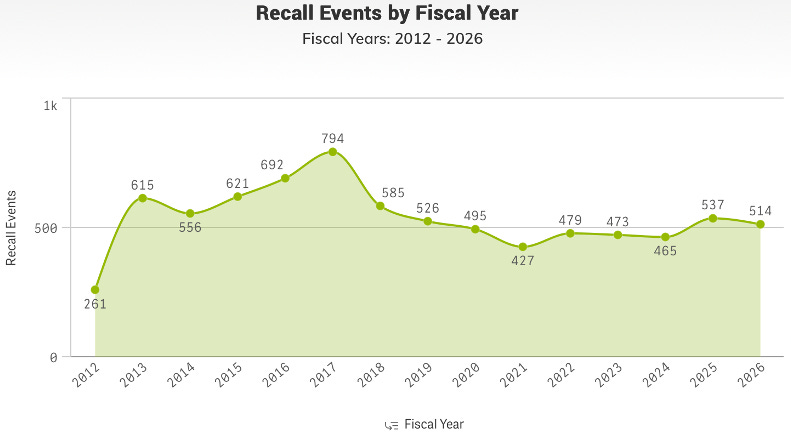
FDA has recorded an average of about 530 food-related recalls per year over the last decade. As of August 28, FDA had recorded 514 food recall events in fiscal year 2026, putting the year on pace for roughly 550.
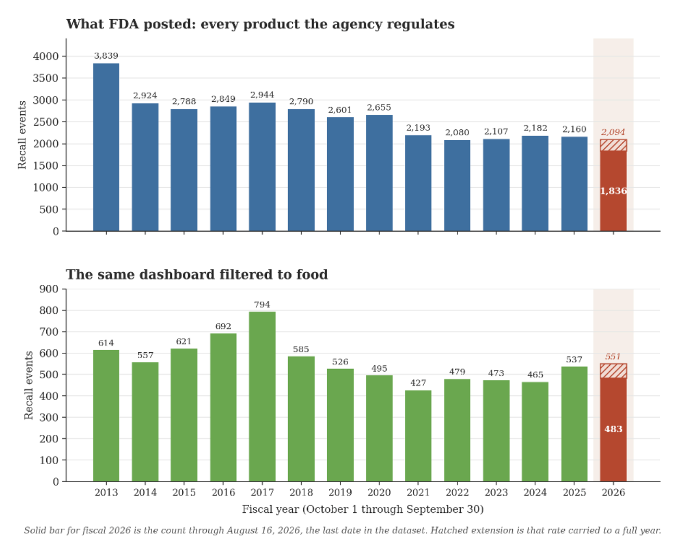
That became a point of controversy in late August, when the official FDA account posted a chart on X and wrote: “Don’t believe the fake news. Our data tells the true story of public health protection. FDA recalls FY2026 (1,836) remain among the lowest levels recorded in over a decade.”
But the posted chart was highly misleading, and not specific to food recalls. Instead, it included recalls across all FDA-regulated products, including drugs, medical devices, tobacco products, veterinary products, biologics, and food.
Dr. Susan Mayne, the former director of FDA’s Center for Food Safety and Applied Nutrition, wrote on LinkedIn that she thought the numbers “looked way off.” So she checked the agency’s own dashboard, filtered it specifically for food, and found 483 food recall events through August 16, which would annualize to about 550, putting 2026 above the annual average over the last decade and on pace for the highest number of food recalls since 2018.
Food safety attorney Bill Marler then compared the two versions of the FDA data side by side, showing how different the picture looks once the dashboard is filtered specifically for food. He also highlighted how the FDA’s dashboard only includes recalls after they have been formally classified, which can take weeks or months, meaning some recent recalls may not be reflected in the 2026 total.
But ultimately the number of recalls does not tell us whether or not the food supply is safer. Recall counts only measure how many products are recalled, not necessarily how many people become sick. And recalls can happen for many different reasons besides microbial contamination that are unrelated to infectious foodborne disease, including undeclared allergens, foreign objects, labeling problems, or other regulatory violations.
What matters more than the number of recalls is how well the system can detect outbreaks, monitor and trace contaminated food, and act quickly enough to prevent additional illnesses.
And that is where the current cuts to the food safety system become especially important.
Cuts to Food Safety
The U.S. food safety system depends on federal, state, and local public health agencies working together. The FDA and USDA regulate the food supply, while the CDC and state and local health departments work to detect illnesses, identify outbreaks, test samples, trace contaminated foods, and communicate to the public.
A lot of that work happens at the state and local level, but much of it depends on federal funding and coordination. So cuts at agencies like the FDA and CDC can mean fewer people and resources available to investigate outbreaks in communities across the country.
But over the last year and a half, that is exactly what we have seen happen. Federal cuts have reduced staffing, funding, laboratory capacity, surveillance, and other resources across the agencies responsible for keeping the food supply safe.
The scale of the staffing losses alone has been substantial. The FDA, CDC, and USDA have lost roughly 20%, 25%, and 27% of their workforces, respectively, through layoffs, buyouts, and other workforce reductions. The CDC had 11 scientists specifically tracking food parasites. Now only three remain. FDA food safety scientists and inspectors were also affected, including food toxicologist staff at FDA responsible for evaluating chemical risks in the food supply. And at USDA, the Food Safety and Inspection Service lost about 8% of its workforce.
Some senior career officials also resigned in protest over anti-science decisions at the agencies. The CDC’s food safety lead resigned after RFK Jr. attempted to fire the agency’s director, citing a departure from evidence-based science. And Jim Jones, who led the FDA’s Human Foods Program, resigned in protest, stating he could no longer effectively protect the food supply under the current conditions.
But the losses extend well beyond personnel.
The administration delayed the FDA’s Food Traceability Rule until 2028, postponing requirements designed to help investigators trace high-risk foods through the supply chain more quickly. Three USDA Cyclospora projects were stopped this August during the largest Cyclospora outbreak on record. And foreign food safety inspections have fallen to historic lows. CDC also scaled back FoodNet, which is its longstanding active surveillance system for foodborne disease, while USDA eliminated scientific advisory committees that helped inform food safety policy.
As these changes were being made, food safety experts warned that these cuts could leave the country more vulnerable to foodborne illness outbreaks. And while it is impossible to connect one single cut to any increase in illness, the concern is that these cuts compound one another and weaken the system’s ability to contain outbreaks before more people get sick.
What Should Consumers Do?
Current outbreaks may reasonably make people more cautious, especially when specific products are implicated. But they are not a reason to broadly avoid fruits, vegetables, or other whole foods. There are several things you can do to help reduce risk and advocate for a safe food supply.
At home, basic food safety practices can reduce the risk of foodborne illness: wash your hands, keep raw foods separate from ready-to-eat foods, cook foods to safe temperatures, put food in the fridge right away, and rinse produce under running water.
For recalls or outbreaks, the FDA has a current list of food recalls and safety alerts, and the USDA has the same for meat, poultry, and certain egg products. Be sure to check the specific brands, lot numbers, and locations, rather than assuming an entire category of food is unsafe.
And ultimately, consumers can only do so much on their own. Food safety depends on strong federal public health agencies and state and local health departments. Advocating for adequate funding for those systems, and opposing cuts to them is part of protecting the food supply too.
If you found this helpful and are able to support this work, please consider becoming a paid subscriber. Your support helps me keep spending the time it takes to research, write, and share pieces like this, and I’m genuinely grateful for it. Thank you for being here.
Thank you, Dr. Knurick, for your work on spreading awareness about the dangers of the cuts this administration has made. They (Elon, for example) claimed they were "cutting waste" to save our country money, when they really just cut out departments that didn't personally serve them or that they straight up didn't understand the importance of (because they're ignorant and unqualified)! It's absolutely maddening.
You're the best, and you're still in my thoughts after the loss of your mom <3
You may want to check out Project 2025’s chapter 13 on food destabilization.